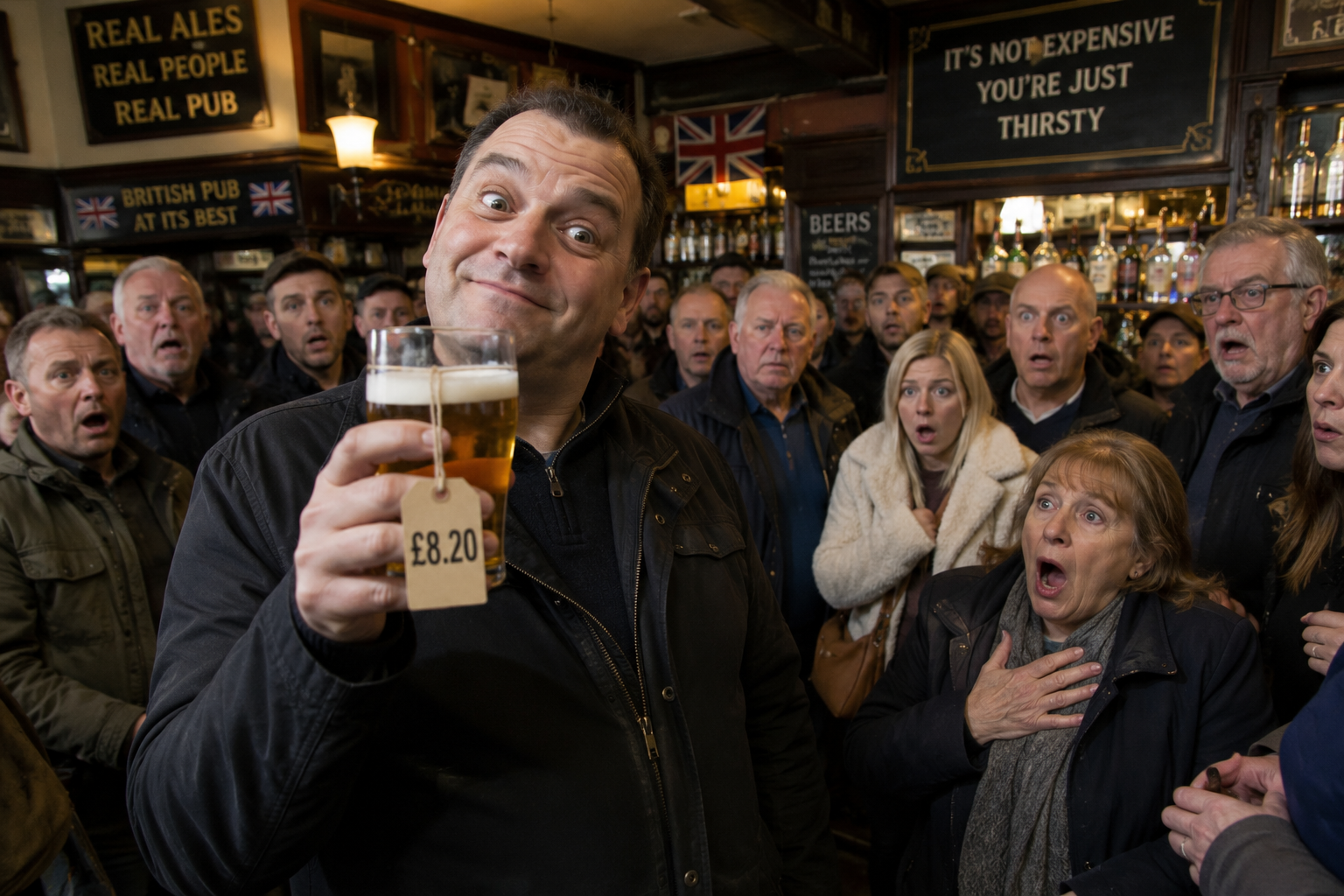
A local man has been hailed as both a financial optimist and a national security threat after confidently describing an £8.20 pint as "actually not too bad" during a visit to his local pub on Friday evening.
Witnesses say 37-year-old marketing executive Daniel Fletcher made the remark while standing at the bar of The King's Arms, moments after ordering a pint of premium lager and briefly checking his bank balance "just to make sure it was still there."
The statement reportedly stunned nearby drinkers, many of whom had gathered to complain about the rising cost of living, rail fares, mortgages, energy bills and, most importantly, the increasingly eye-watering cost of a pint in Britain.
"It's all relative now," Fletcher explained while carefully nursing his drink as though it were a rare museum artifact. "A few years ago I'd have fainted at £8.20. Now I see anything under £9 and think I've somehow beaten the system."
Britain's Relationship With Expensive Pints.
Experts have long studied the peculiar British ability to accept almost any price increase provided it happens gradually enough.
According to unofficial figures gathered from conversations in pub beer gardens, many drinkers now measure affordability not by actual value, but by whether the price causes them to swear audibly when ordering.
"If you don't involuntarily say 'bloody hell' when the bartender tells you the price, people increasingly view it as a bargain," explained amateur economist and part-time darts player Steve Hammond.
Researchers believe years of inflation, shrinking packet sizes and premium pricing have fundamentally altered public expectations.
A generation that once considered £5 for a pint outrageous now celebrates finding one for £6.50 in central London, often photographing it and sending evidence to friends like a rare wildlife sighting.
Public Reaction Divided.
News of Fletcher's comments quickly spread throughout the pub, creating heated debate among customers.
One patron described the statement as "deeply troubling".
Another suggested Fletcher had simply reached the final psychological stage of modern British consumerism, where acceptance replaces resistance.
"I remember when a pint was three quid," said local resident Alan Briggs. "Now every time I buy a round I need to move money between accounts first. But somehow he's got a point. £8.20 does sound reasonable these days, and that makes me very uncomfortable."
Several customers admitted they had experienced similar moments of surrender.
One woman revealed she recently paid £14.50 for a cocktail and spent the rest of the evening convincing herself it had been an investment.
Pub Industry Celebrates Breakthrough.
Representatives from the hospitality sector welcomed the development.
Industry insiders described Fletcher's comments as a significant milestone in Britain's evolving relationship with pricing.
"For years we've been trying to identify the exact point at which customers stop being shocked and start defending the prices themselves," said one pub manager.
"It appears we've found it."
Sources suggest some establishments are already considering marketing campaigns based on the discovery.
Potential slogans reportedly include "Only Slightly More Than You Expected" and "At Least It's Not London Prices."
Meanwhile, premium venues are said to be exploring £10 pints, confident customers will eventually refer to them as "pretty standard."
Cost Of Living Crisis Reaches Beer Gardens.
The story has reignited discussion surrounding inflation and consumer spending habits across the UK.
Many economists believe pub prices provide a surprisingly accurate measure of public sentiment.
"When people start normalising £8 pints, it tells us something important about expectations," explained financial analyst Rebecca Turner.
"Consumers don't necessarily become wealthier. They simply adjust their definition of expensive."
This phenomenon has reportedly spread beyond pubs.
Recent surveys found people describing £4 coffee as "fair enough", £17 burgers as "about average" and streaming subscriptions costing more than a gym membership as "basically free."
Experts warn that continued exposure may eventually lead Britons to describe house deposits as "quite manageable."
The Pub Visit Continues.
Despite the controversy, Fletcher remained unapologetic.
After finishing his pint, he reportedly ordered a second without checking the price.
Witnesses described the act as either bravery or complete financial exhaustion.
By 9pm he had reportedly spent more than £30, yet maintained that he had enjoyed "a relatively cheap night out."
Friends later intervened and escorted him home after he began describing £6 train fares as "great value."
Medical professionals say recovery remains possible but may require several weeks of exposure to pub menus from 2015.
Nation Watches Nervously.
As debate continues, many Britons are left questioning their own spending habits.
Some fear Fletcher represents the future of consumer behaviour.
Others argue he merely voiced what millions have secretly been thinking every time they tap their card and try not to make eye contact with the payment terminal.
At the time of publication, The King's Arms had increased the price of the same pint to £8.45, citing "market conditions" and the unexpected media attention.
Regular customers described the increase as disappointing but, ultimately, "not too bad."
After all, as several patrons pointed out, it's still under a tenner.
Have pub prices finally broken Britain's collective sense of value, or is £8.20 genuinely reasonable in 2026? Share your thoughts in the comments and join the debate.