
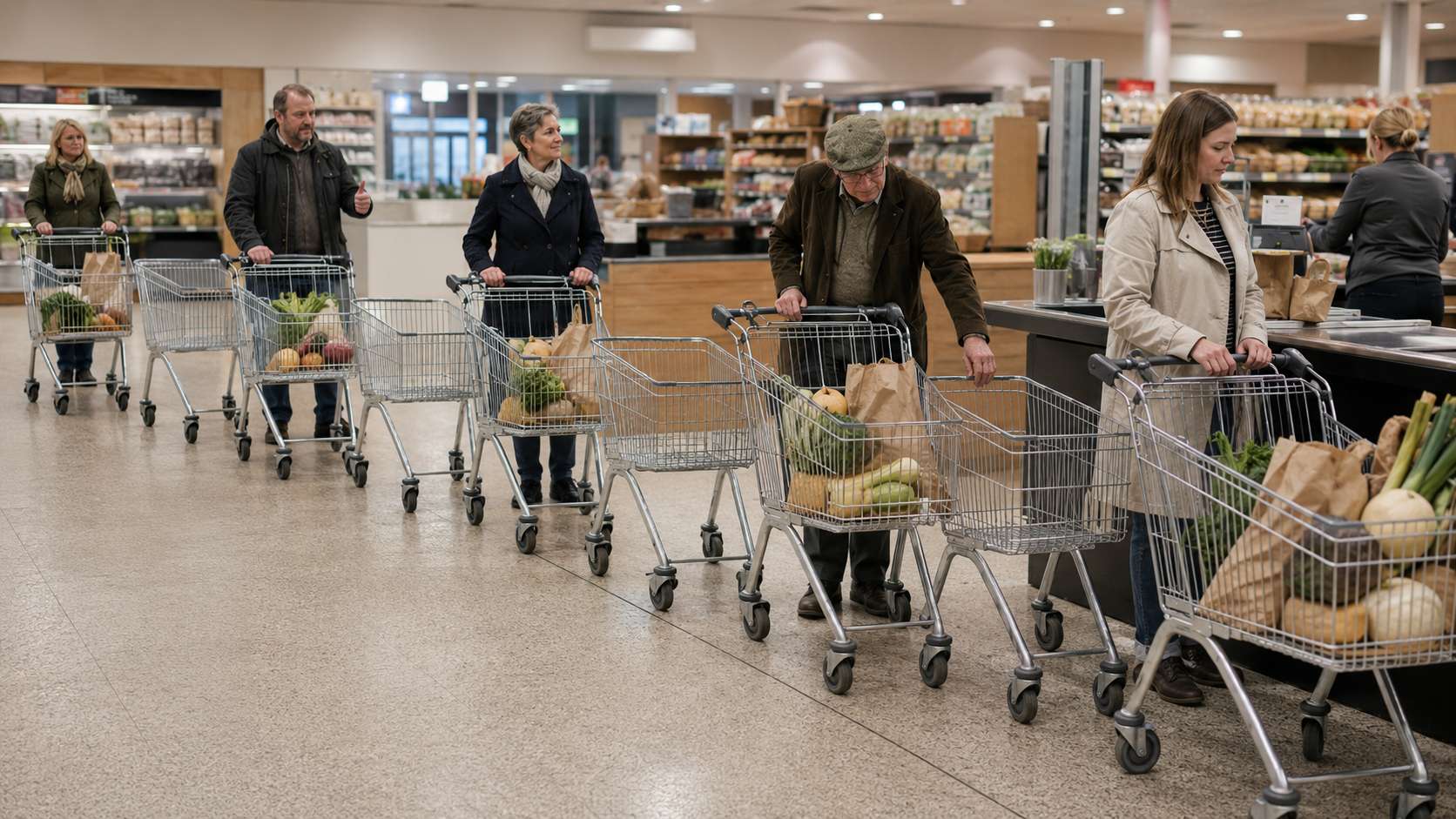
The debate began after a survey asked people how closely they stand behind the person ahead. Answers measured in centimetres proved difficult to imagine, so residents translated the options into familiar objects.
A full trolley was considered too large for smaller shops. A basket provided insufficient protection when the person ahead stepped backwards to inspect chewing gum. One sensible trolley emerged as the compromise.
The definition of sensible required further work.
Residents in Spalding described it as a trolley containing a weekly shop without large garden items. Boston participants excluded child seats because folded seats altered the visual boundary. In Lincoln, several people argued that the correct measure should include the space required to turn a trolley without touching a display of promotional biscuits.
Queue behaviour changes according to location. Supermarket lines allow equipment to define the gap. Post offices rely on floor markers when available. Cafe queues become less clear because people stand sideways while reading menus and may appear to leave the line without surrendering their position.
The most sensitive moment occurs when a new checkout opens. An orderly queue can reorganise instantly as shoppers calculate distance, basket weight and whether moving would look undignified.
Participants agreed that the person at the front of the original line should receive first opportunity. They also accepted that this principle becomes difficult to enforce once somebody has already committed to the new lane at speed.
The trolley measure has no official status and requires no changes from shops. It developed as a practical way of describing personal space during an everyday British activity.
Accessibility remains important. Some customers need additional room, assistance or time to move through a checkout. Courtesy works better than a rigid measurement, especially in crowded or narrow spaces.
The discussion also covered divider placement. Most shoppers place the bar behind their own groceries once unloading is complete. Failure to do so creates a pause in which the next customer must decide whether reaching across appears helpful or critical.
Lincolnshire participants proposed that divider bars should count as miniature public services. They separate property, reduce confusion and spend most of the day being pushed away from the place where they are needed.
The survey concluded without identifying a national queue distance. Preferences depend on context, crowding and the confidence of the person holding a basket.
The sensible trolley remains the leading local suggestion. It provides room to move, a place for shopping and a physical barrier against anyone attempting to join the queue through optimistic sideways positioning.
Residents acknowledge that the system cannot work everywhere. In a bakery, one trolley would occupy most of the premises and leave no space for the person who only came in for a loaf but is now considering three pastries.
